

Table of Contents
- Quick Comparison: Professional-Grade Knee Braces and Prices
- What Makes a Knee Brace Professional-Grade and Durable?
- Why Physiotherapist Recommended Knee Braces Are Worth the Investment
- How to Measure for a Knee Brace Before You Order
- TGA Registered Knee Supports: What Registration Actually Means
- Fast Australia-Wide Delivery and Returns: What to Expect
- Material Durability and Maintenance: Making a Brace Last
- Conclusion: Choosing the Right Brace for Your Recovery
- Frequently Asked Questions
Last Updated: September 18, 2026
Quick Comparison: Professional-Grade Knee Braces and Prices
Finding durable, professional-grade knee braces Australia wide comes down to matching the brace to your injury, size and recovery stage. REHABESHOP stocks clinical-grade knee supports with fast Australia-wide delivery and a 14-day return policy on unused items. (Source: guidelines for medical devices)
| Brace | Price | Type | Best For |
|---|---|---|---|
| Bracewear Air-X F Entry Pace MK2 ROM | $299.74 | Hinged ROM | Post-operative rehab, controlled range of motion |
| Bauerfeind GenuTrain S | $392.91 | Hinged sleeve | Medial or lateral ligament injury, residual instability |
| CTi 3 | $760.13 | Rigid carbon frame | High-impact sport, ligament protection |
| Bauerfeind SecuTec Genu | $952.59 | Rigid frame | Post-surgical stabilisation, cruciate and meniscus injuries |
| Ossur Rebound Dual | $981.05 | Rigid frame | Combined ligament instability plus mild to moderate osteoarthritis |
| Breg Axiom Elite Dynamic | $1,214.50 | Rigid frame | ACL or PCL protection in high-demand sport |
| Breg Fusion XT | $1,214.50 | Rigid frame | Maximum ligament stability, injury prevention |
| Ossur Unloader One X | $1,382.49 | Unloading frame | Unicompartmental osteoarthritis, degenerative meniscal tears |
| Medi M.4s Comfort | $1,635.00 | Rigid frame | Cruciate or collateral rupture, conservative or post-operative care |
| Ossur Rebound ACL | $2,857.98 | Dynamic frame | ACL injuries, post-operative stabilisation |
What Makes a Knee Brace Professional-Grade and Durable?
A professional-grade knee brace is built around a rigid or semi-rigid frame, clinical-grade materials and a mechanism that controls how your knee moves, rather than simply wrapping it in elastic. Durability comes from the frame material, hinge design and quality of liners and straps.

Hinged, Sleeve or Rigid Frame: Matching the Brace to the Job
Three broad categories cover most needs, and picking the wrong one is a common mistake.
- Compression sleeve: knit support with no hinge. Best for mild swelling, patella tracking support and proprioception during light activity. Not enough for ligament instability.
- Hinged brace: a sleeve or frame with mechanical hinges at the joint. Controls side-to-side movement and supports ligament healing. The Bauerfeind GenuTrain S and the Bracewear Air-X ROM both sit here.
- Rigid frame brace: a full frame spanning thigh to lower leg. Used for cruciate ligament injuries, post-operative stabilisation and high-impact sport. The Breg Fusion XT and Medi M.4s Comfort are examples.
Why Physiotherapist Recommended Knee Braces Are Worth the Investment
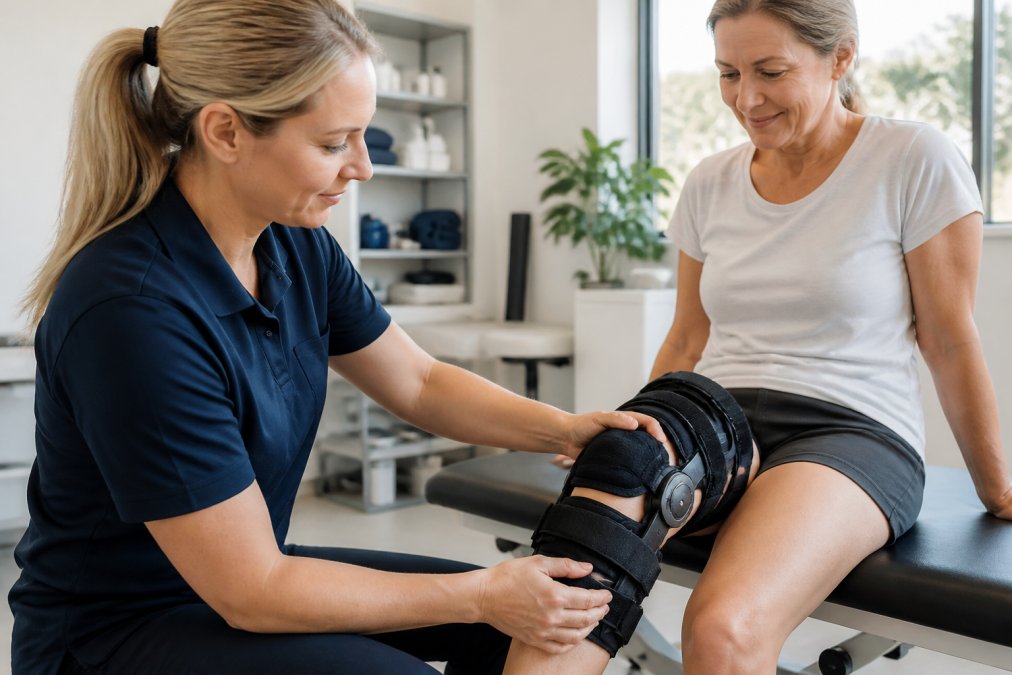
Physiotherapists recommend specific braces because frame geometry and hinge design change how load travels through the joint. A brace that unloads the correct compartment or limits movement in the right plane supports rehab in ways a generic sleeve cannot.

How to Measure for a Knee Brace Before You Order
Correct sizing matters more than any other factor in whether a brace works, and it is the biggest reason clinical-grade braces get returned. Measure the affected leg, not the healthy one, in the morning before swelling builds if you can.
Use these steps:
- Sit with your leg straight and muscles relaxed.
- Measure the knee circumference at the centre of the kneecap.
- Measure thigh circumference 15 cm above the kneecap.
- Measure calf circumference 15 cm below the kneecap.
- Compare all three measurements against the supplier's size guide for that specific brace.
- Choose the side (left or right) if the product lists one.
Why Morning Measurements Matter More Than You Think
A knee that has been weight-bearing all day can measure 1-2 cm larger than the same knee in the morning, particularly in the first few weeks after surgery or during an inflammatory flare. Order to an afternoon measurement and the brace will be too loose once swelling settles, and a loose rigid frame migrates during walking, defeating the hinge geometry.
Sizing Is Brand-Specific, Not Universal
A medium in one brand is not a medium in another. Bauerfeind, Ossur, Breg and Medi each publish their own circumference ranges, and the overlap between a 'medium' in one and a 'medium' in another can be several centimetres. Always check the size guide on the individual product page.
Measure in the morning, measure all three points, and check the specific brand's size chart. If you are between sizes with active swelling, size up and use the straps. ::: (Source: Australian Competition and Consumer Commission (ACCC) consumer guarantees)
Claiming a Private Health Insurance Rebate on a Knee Brace
Many Australian private health insurers allow a claim on clinically indicated knee braces under extras cover, but rules vary by fund and policy tier. Before you order, check three things:
- Whether your extras cover includes 'orthopaedic appliances' or 'medical aids', the wording differs between funds.
- Whether a referral or prescription from a physiotherapist, orthopaedic surgeon or GP is required for the claim.
- Whether there is an annual sub-limit that the brace price would exceed.
TGA Registered Knee Supports: What Registration Actually Means
The Therapeutic Goods Administration (TGA) regulates therapeutic goods in Australia, and knee braces intended for a therapeutic purpose generally fall within its scope. Registration or inclusion on the Australian Register of Therapeutic Goods (ARTG) means the sponsor has demonstrated the product meets applicable regulatory requirements for its class.
Fast Australia-Wide Delivery and Returns: What to Expect
Ordering knee braces Australia wide online only works if they arrive when you need them. REHABESHOP ships Australia-wide, so a brace ordered for an upcoming physio appointment reaches most locations without a long wait, and the 14-day return policy covers unused items if the fit is not right.
A few practical points before you order:
- Order early if you have a scheduled appointment or surgery date.
- Check the sizing twice. Returns are simpler when the item is unused.
- Keep the packaging until you have confirmed the fit.
- If you are unsure between two braces, ask your physiotherapist first rather than ordering both.
Material Durability and Maintenance: Making a Brace Last
A clinical-grade brace should outlast several cheap sleeves, but only with basic care. The frame and hinges are durable; liners, straps and padding wear out first, on a predictable schedule most product pages never mention.
What Actually Fails, and When
Across hinged and rigid-frame braces, the failure pattern is fairly consistent:
- Liners and padding: the first components to degrade, typically within 3-6 months of daily wear. Sweat, body oils and repeated washing break down the foam and the anti-migration grip.
- Straps and hook-and-loop closures: lose holding power after roughly 6-12 months of regular use, especially if they are overtightened to compensate for a stretched liner.
- Hinge mechanisms: usually the last to fail, but they are the most expensive to replace. Grit and dust are the main enemies, a hinge that starts clicking or catching usually needs professional service, not a spray of lubricant.
- Frame and shell: designed to last the life of the brace. Carbon and aluminium frames rarely fail unless they are dropped onto hard surfaces or exposed to prolonged heat.
A Weekly Maintenance Routine That Works
- Follow the manufacturer care label for every component, most liners are hand-wash only and air-dry, and a tumble dryer will destroy the foam.
- Wipe the frame and hinges with a damp cloth after outdoor use to remove grit.
- Air the brace out after every wear; do not seal it in a bag while damp.
- Inspect hinges, straps and liners weekly for wear, cracking or loss of grip.
- Store away from direct heat and moisture, a car boot in summer is the worst place for a carbon frame and foam liner.
- Replace worn liners and straps rather than the whole brace where the brand supports it.
Matching Maintenance to Your Recovery Timeline
Brace care is not the same at every stage of rehab. In the first two weeks after surgery, swelling is highest and the liner is under the most stress, clean it more often and check the skin underneath daily. Mid-rehab, when wear hours are longest, strap and liner wear accelerates. Late rehab and return-to-sport, most people are down to a lighter support, and the rigid frame can be cleaned, inspected and stored for any future flare.
Conclusion: Choosing the Right Brace for Your Recovery
The hardest part is not finding a durable brace. It is matching the brace to your injury, recovery stage and measurements, then getting it in time to use it.
Frequently Asked Questions
What features define a professional-grade knee brace?
Professional-grade knee braces typically use rigid or semi-rigid frames, precision hinges that follow natural knee movement, and adjustable straps for a secure fit. Materials like carbon fibre or aircraft aluminium provide strength without excess weight. Breathable liners and anti-migration features keep the brace comfortable and in place during activity. These design elements support joint alignment and load distribution, which matters for ligament protection and rehabilitation. At REHABESHOP, braces like the Breg Fusion XT and CTi 3 are examples of this construction.
Are there TGA registered knee supports available online?
Many knee braces sold online are listed on the Australian Register of Therapeutic Goods (ARTG), which is managed by the Therapeutic Goods Administration (TGA). Registration means the product meets the TGA's requirements for safety and quality, but it does not replace individual medical advice. Always check the product listing or ask the supplier for the ARTG number. REHABESHOP stocks products from established orthopaedic brands that are commonly listed on the ARTG, so you can shop with confidence.
How do I measure for a knee brace to get the right fit?
Use a soft measuring tape to measure the circumference of your leg at two points: mid-thigh (about 15 cm above the kneecap) and mid-calf (about 15 cm below the kneecap). Also note whether you need a left or right specific brace. Compare your measurements to the supplier's size guide for each product. If you are between sizes or have significant swelling, ask a physiotherapist which fit is appropriate. A brace that is too loose will slip; one that is too tight can restrict circulation.
What is the typical delivery timeframe for medical-grade braces?
Delivery times vary by supplier and your location. Many Australian-based online stores dispatch orders within one to two business days and use express shipping for faster arrival. REHABESHOP offers fast, reliable Australia-wide delivery, so you can expect your brace to arrive within a few business days, depending on your postcode. If you need a brace for a specific appointment, order early and choose express shipping at checkout. Check the store's shipping page for current timeframes.
0 comments