

Table of Contents
- Hinged Braces for Sports: What the Evidence and Experience Show
- What a Hinged Knee Brace Actually Does
- When Hinged Support Helps, and When It Doesn't
- Quick Comparison: Hinged Knee Braces Reviewed
- Hinged Knee Brace vs Compression Sleeve: Which Do You Need?
- When to Wear a Hinged Knee Brace During Sport
- How to Choose the Right Sports Knee Brace
- Risks and Trade-Offs: Brace Dependency and Muscle Atrophy
- Conclusion: Are Hinged Braces Worth It for You?
- Frequently Asked Questions
Last Updated: September 23, 2026
Hinged Braces for Sports: What the Evidence and Experience Show
Are hinged braces worth it for sports? For athletes recovering from ligament injuries or managing instability, a hinged brace provides meaningful mechanical support during high-risk movement. But they are not a universal solution, and prevention evidence in healthy knees is weaker than marketing suggests.
What a Hinged Knee Brace Actually Does
A hinged knee brace has mechanical hinges on each side of the joint that control how the knee bends and straightens. Unlike a sleeve, it provides structural stability against sideways forces and hyperextension.
- Ligament support: The rigid frame and straps resist abnormal movement that stresses the ACL, MCL, or LCL.
- Range of motion control: Adjustable hinges can limit how far the knee bends or straightens, which matters after surgery.
- Proprioception: The brace gives your brain more feedback about where your knee is in space, which can improve joint awareness.
- Load distribution: Forces are spread across a wider area rather than concentrated on healing tissue.
When Hinged Support Helps, and When It Doesn't
Hinged support helps most with a diagnosed reason: a recent ligament injury, post-operative recovery, or documented joint laxity. The brace protects healing tissue while you rebuild strength.
Quick Comparison: Hinged Knee Braces Reviewed
The right brace depends on your injury, sport, and recovery stage. Here is how the main options compare.
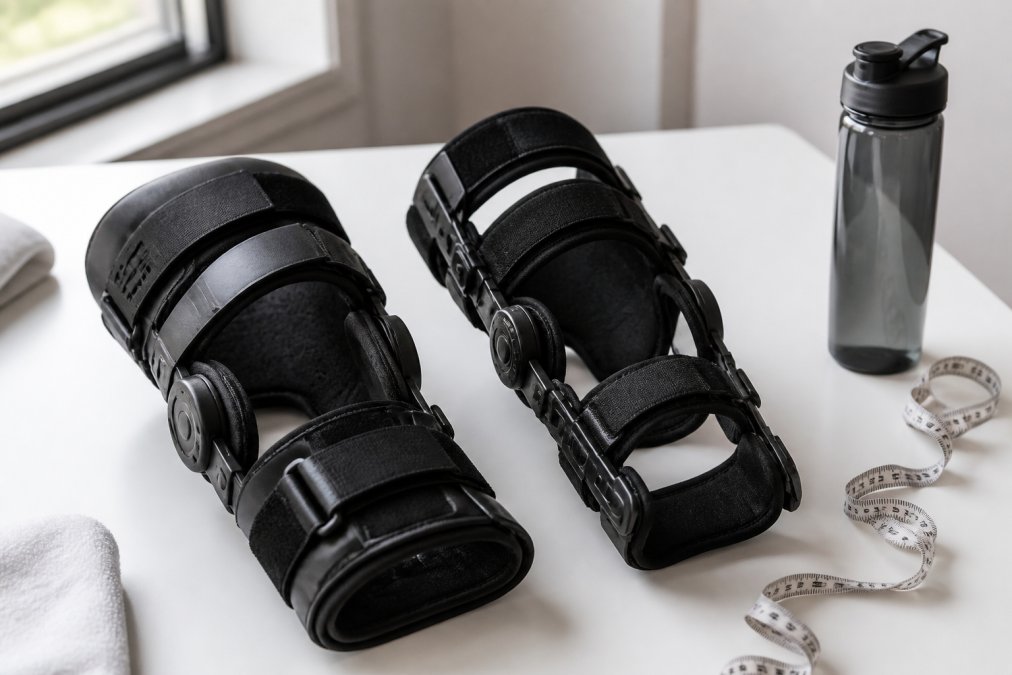
| Brace | Price | Support Level | Best For |
|---|---|---|---|
| CTi 3 | $760.13 | High, carbon fibre frame | High-impact sport, ligament protection |
| Breg Axiom Elite Dynamic | $1,214.50 | Very high, rigid frame | ACL or PCL injury and reconstruction |
| Breg Fusion XT | $1,214.50 | Very high, aluminium frame | Maximum ligament stability in sport |
| Bauerfeind GenuTrain S | $392.91 | Moderate to firm | Medial or lateral ligament injury |
| Bracewear Air-X F Entry Pace MK2 ROM | $299.74 | Adjustable ROM | Post-operative and rehab programs |
| Bracewear Air-X Wrap FE | $185.83 | Mild to moderate | Injury recovery, easy wrap fit |
| Bracewear Air-X Pace Knee Short | $269.76 | Mild ACL/PCL | Mild instability during recovery |
| Bracewear Air-X Low Profile | $167.85 | Mild medial/lateral | Active lifestyle, daily wear |
| Orthocare Genucare Stable | $101.11 | Mild to moderate | Knee sprains, everyday stability |
| MediRoyal ARX Liga Light | $176.69 | Medium | Mild to moderate instability, patella issues |
Hinged Knee Brace vs Compression Sleeve: Which Do You Need?
A hinged knee brace controls joint movement with mechanical hinges, while a compression sleeve supports through fabric pressure alone. They solve different problems, and choosing wrong wastes money.

| Feature | Hinged Brace | Compression Sleeve |
|---|---|---|
| Mechanical support | Yes, via hinges | No |
| Limits hyperextension | Yes | No |
| Controls lateral movement | Yes | Limited |
| Bulk under clothing | Higher | Minimal |
| Best stage | Rehab and return to sport | Mild symptoms, daily wear |
When to Wear a Hinged Knee Brace During Sport
Wear a hinged brace during sport when a clinician recommends it for your injury, or during return-to-sport after ligament surgery. The decision hinges on your sport's movement demands: a brace essential for rugby is often unnecessary for cycling.
Contact sports: rugby, football, basketball
These sports involve collisions, rapid direction changes, and unpredictable forces. A hinged brace with a rigid frame and polycentric hinges resists valgus and varus forces, sideways stresses on the MCL and LCL, and helps prevent hyperextension during tackles or landings.
Non-contact sports: running, cycling, swimming
Running and cycling involve repetitive linear motion with minimal lateral force. A hinged brace is rarely necessary unless there is a specific diagnosis such as a meniscal tear limiting range of motion, or a post-operative protocol requiring ROM control. For most runners and cyclists, a compression sleeve or no support suffices once strength is restored.
Pivoting and cutting sports: tennis, netball, soccer
These sports sit between contact and non-contact: the knee faces deceleration, pivoting, and sudden direction changes, but without external collision. A hinged brace can be valuable during return-to-sport, particularly after ACL reconstruction. Use it for sessions that replicate match demands, not every jog or gym session.
Sport-specific bracing checklist
- Identify the highest-risk movement in your sport (e.g., landing from a jump, side-step cutting, being tackled)
- Match brace type to that movement: rigid frame for collision and pivoting, ROM hinge for controlled rehab, sleeve for linear activity
- Confirm the brace stays in place during a sport-specific drill, not just a walk around the room
- Check whether your sport's governing body has any restrictions on brace type or material (some contact sports have rules about hard external devices)
- Plan unbraced exposure in low-risk sessions to maintain proprioceptive calibration
The unique angle: movement analysis before purchase
Consider the most common knee-loading movements in your sport, then ask your physiotherapist whether a hinged brace changes those mechanics in a way that helps or hinders. For a rugby player, that is the tackle and the ruck; for a netballer, the landing and the pivot; for a cyclist, the pedal stroke, where a hinged brace is usually irrelevant.
How to Choose the Right Sports Knee Brace
Work through these criteria:
- Confirm your injury with an orthopedic assessment before buying
- Match support level to your stage: ROM control for early rehab, rigid frame for return to sport
- Check hinge type: polycentric hinges follow natural knee motion better than single-axis
- Measure your knee circumference and choose the correct size
- Confirm left or right side where the product is side-specific
- Test fit: secure but not tight enough to cause numbness or tingling
- Check that the brace stays in place during a trial run or training session
If between sizes or managing swelling, ask a healthcare professional which fit is appropriate. Sizing varies by product.
Risks and Trade-Offs: Brace Dependency and Muscle Atrophy
The biggest risk of long-term brace use is what happens when it replaces strengthening work. Unloaded muscles can lose capacity, and the nervous system may learn to rely on external support rather than its own feedback loops.
The atrophy mechanism
When a hinged brace takes over part of the load the quadriceps and hamstrings normally manage, those muscles work below their usual threshold. Over weeks and months, this reduced demand can cause declines in cross-sectional area and strength, disuse atrophy. The effect may be most pronounced in the quadriceps, the knee's primary shock absorber during landing and deceleration.
The 'crutch effect' and proprioceptive dependency
Proprioception is your body's sense of where the joint is in space. A hinged brace adds external feedback through pressure and contact, helpful early in rehabilitation, but the brain can become dependent on that input. When the brace comes off, the athlete feels unstable not because the knee is unstable, but because the nervous system has not practised without the brace's signals.
Altered biomechanics and the kinematic chain
A brace can change how you move. Even a well-fitted hinged brace may alter knee flexion angles, hip strategy, and ankle loading during cutting and landing. Short term, this may protect healing tissue; long term, it can create compensatory patterns elsewhere in the leg. These changes are manageable when bracing is time-limited and paired with movement retraining, but can become a problem when the brace is worn indefinitely without reassessment.
Compliance and the real-world trade-off
A brace that is uncomfortable, migrates, or takes too long to put on gets left in the bag. That matters: inconsistent use during return-to-sport exposes the healing ligament to unpredictable loads. The best brace is the one you will actually wear correctly for the duration your clinician recommends, not the most expensive or rigid.
How to taper without losing ground
Use the brace as a tool within a rehabilitation program, not a permanent substitute. A practical taper:
- Phase 1 (early rehab): Full-time brace use as directed, with ROM limits if prescribed.
- Phase 2 (strength rebuilding): Brace for sport-specific drills, but remove it for controlled strength work in the gym.
- Phase 3 (return to sport): Brace for high-risk sessions (contact, cutting, pivoting), unbraced for linear running and low-risk drills.
- Phase 4 (full clearance): Taper to no brace for most sessions, keeping it available for occasional high-risk exposure if your physiotherapist advises.
Conclusion: Are Hinged Braces Worth It for You?
Hinged braces are worth it when you have a diagnosed injury, a clear rehabilitation plan, and a specific reason to limit joint movement during sport. They are not worth it as a generic purchase for a healthy knee or to avoid strengthening work.
Frequently Asked Questions
Can you run with a hinged knee brace?
Many people return to running while wearing a hinged knee brace, but it depends on your injury and stage of recovery. A brace with a rigid frame and adjustable straps can support the joint during straight-line running, while a low-profile hinged support may suit milder instability. Always check with your physiotherapist before resuming running, and start on flat, even surfaces before adding speed or hills.
How many hours a day should you wear a hinged knee brace?
There is no single answer that suits everyone. Some people wear a hinged knee brace during sport and remove it afterwards, while others wear it for most of the day during early rehabilitation. Prolonged use without breaks may reduce your knee's own stability over time. Follow the guidance of your physiotherapist or doctor, and take the brace off for sleep unless you have been told otherwise.
What are the risks of using a hinged knee brace?
The main risks are over-reliance on the brace, reduced muscle activation around the knee, and skin irritation from poor fit. A brace that is too tight can cause numbness, tingling or colour changes, which means you should remove and refit it. Wearing a brace does not replace strengthening work. If you notice increasing instability or worsening pain, see a qualified professional rather than adjusting the brace yourself.
How long do hinged knee braces last?
How long a hinged knee brace lasts depends on the materials, how often you wear it and the sport you play. Braces with aluminium or carbon fibre frames and replaceable liners generally hold up longer than soft fabric supports. Check the straps, hinges and liners regularly for wear, and follow the manufacturer's care instructions. Replacing worn liners or straps can extend the life of the brace.
Do hinged braces weaken your knee muscles over time?
A hinged knee brace can reduce the work your muscles do if you rely on it constantly and skip strengthening exercises. This is sometimes called brace dependency. The brace itself does not weaken your knee, but the lack of active training can lead to muscle atrophy. Using the brace as recommended by your physiotherapist, alongside a structured strengthening program, is the best way to protect your knee long term.
If you are managing a knee injury or planning your return to sport, getting the right support matters. REHABESHOP offers a curated range of physiotherapist-trusted knee braces, with fast delivery Australia-wide and a 14-day return policy on unused items. Our team can help you match the right brace to your injury and stage of recovery, so you can move with confidence. Get started with REHABESHOP and find the support that fits your recovery.
0 comments